
I’m a big fan of Google’s Summer of Code program — it’s brought a lot of new developers to the Subversion project, and this also seems to be true for many other open source projects.
Summer of Code encourages college students to participate in open source projects over the summer, by funding both the student (for the time spent coding and learning open source processes) and the project (for time spent mentoring). The students earn enough for it to be their main summer job, but they also often stay involved in their projects after the summer is over, which is a sure sign that the program is working. In some cases, a Summer of Code project has led directly to a full-time job offer for a graduating student, too.
This year, Google decided to send every student a signed copy of my book, Producing Open Source Software. Now, the team that runs Summer of Code is the same team I worked in when I was at Google: the Open Source Program Office. But I’m sure they chose the book on its merits, and that there’s no favoritism going on here (so stop muttering under your breath like that, please. No, really, I can still hear you… there, that’s better, thanks.)
Thus it came to pass that a couple of days this spring, I drove down to the Google offices in Mountain View, visited with my old teammates for a while, then went to a cubicle and signed books. Nearly a thousand of them — it took a lot longer than I expected, and my wrist hurt, but on the other hand it was interesting to have a way to physically feel how big the Summer of Code program is. Next time I ask a computer database to iterate over a thousand entries, I’ll do so with some sympathy.
If you received a book, here’s your evidence that the signature is real:
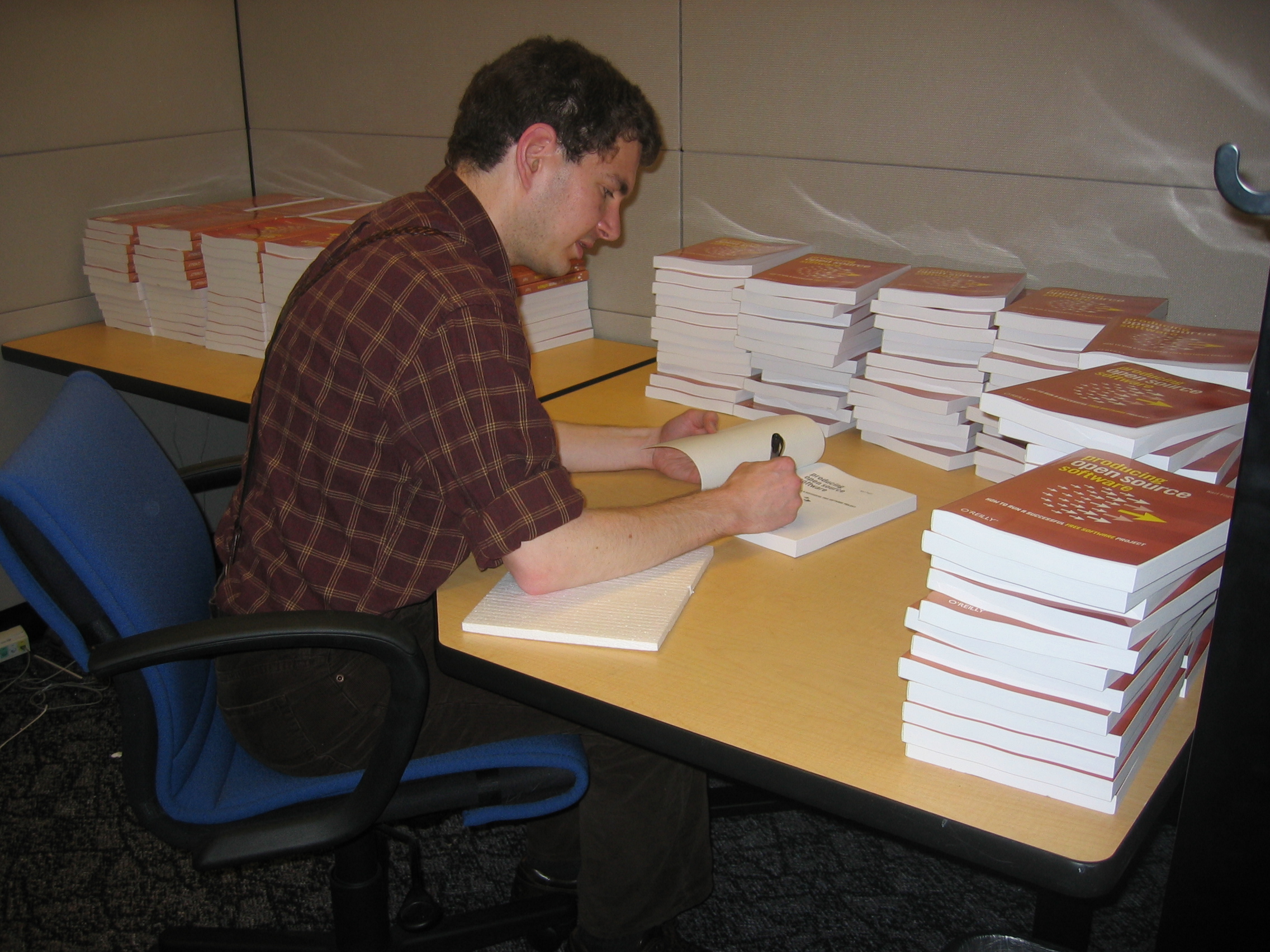
(Notice the pad of paper under the elbow of the signing hand. I’ll bet real authors travel with a special cushion, but that, uh, hasn’t been necessary so far in my case.)
About halfway through the second session, I took a break. The books stacked neatly on the floor in front of the cubicle are done, the ones on the desk are still unsigned:
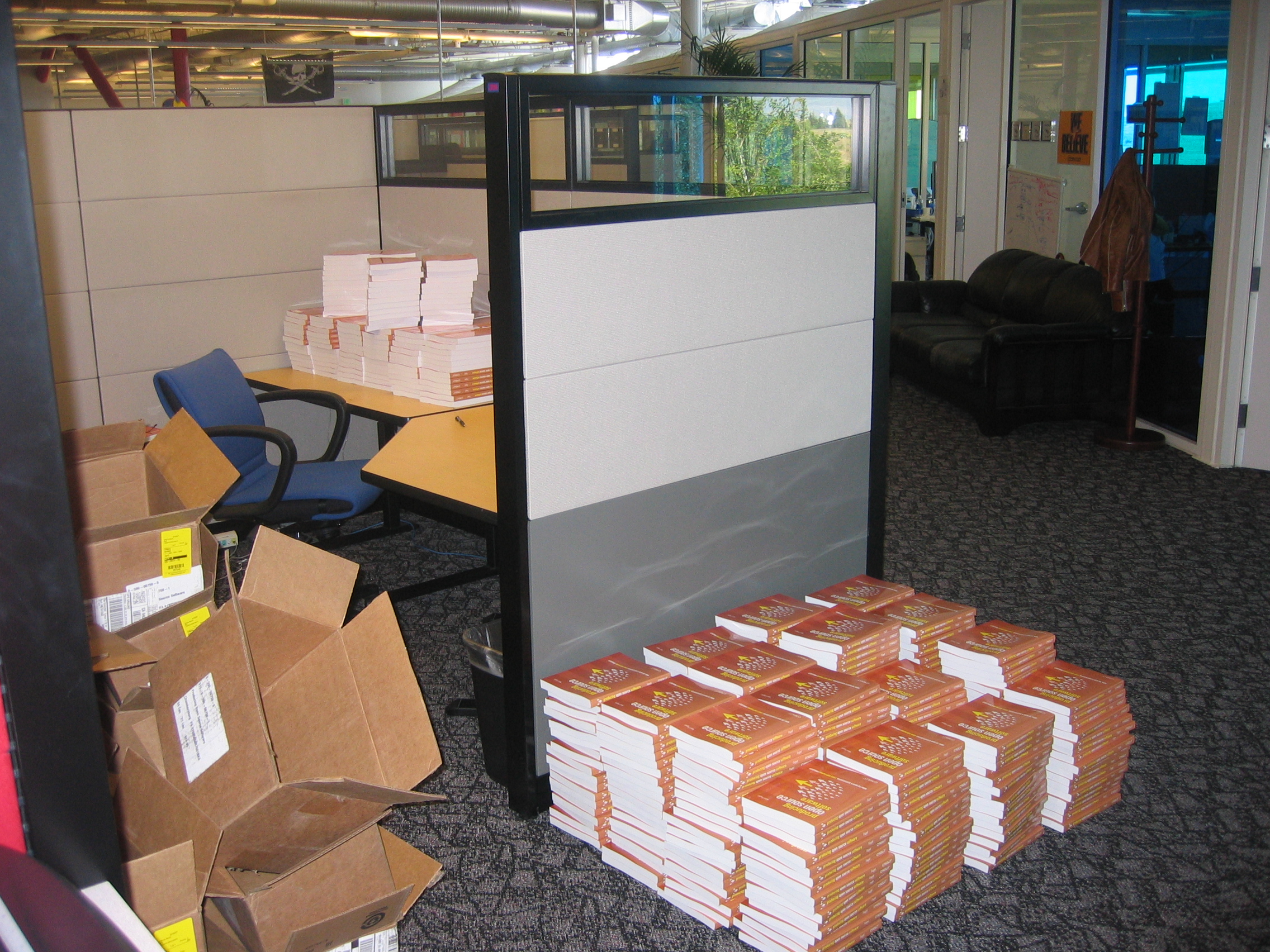
Someone asked me if I signed every book exactly the same way. The answer is yes, except for one: there’s an Easter Egg book with a special message. If you got it, you’ll know it.
This is excellent news and I sincerely hope students read this book and take it to heart because it really describes the Open Source process well, and is a recipe for success. Kudos to everyone in Google who made this giveaway happen, O’Reilly, and of course to you Karl for writing it 🙂
Additionally, everyone would benefit from listening to a talk on this subject given by Ben and Brian here:
http://video.google.com/videoplay?docid=-4216011961522818645
Thanks, Philip — and I totally agree about Ben and Brian’s talk, it’s awesome.
They had to choose a book by someone they’d be able to dragoon into doing all that signing?
I think Rachel’s got this figured out, yeah.
Super thanks man. The book is exciting so far and I’m sure it will be the whole way. I’ve never received a book signed by the author so this is very special…thanks for making it so. I look forward to reading the *whole* book. Once again, super w00tness!!!
The website link is a link to my blog where I’m writing about my journey with my project. So if you’re interested in reading up on some projects, by all means come read and comment!
Hi Karl ! I just got my book. Although mine isn’t the special one, the book is awesome… thank you !
Eric and Igor,
Glad you like it, thanks for writing! (Eric, I’ll check out the link.)
Hi Karl,
Thanks a lot…!! Waiting for my one,,.. hehe. I’m sure the book will be awesome… 🙂
Yeh, this is a good surprise for us. This book is really helps in our Open Source project management. And i realy have one project that need help in organization and management task. I think you book – wre usefull there:)
And thank for sing it. This is second autograph in my collection:)
Hi! Just what students with an open mind and passion for open source need….thanks a ton 🙂
Thanks a lot for the book, it’s just awesome and so interesting! Thanks again!
Hello Karl!
Thanks for the book. It is a really great present!!!
I hope your hand is better now 🙂
Best regards, Georgy Berdyshev
Hey Everyone,
I’m so glad you like the books, and it was a pleasure to sign them for you! The real thanks should go to Google — they arranged this all, and they bought and shipped the books. Compared to that, coming in for a couple of days and signing was easy :-).
Wow, that is a lot of signatures.
So far the book is awesome. I been involved in open source projects for a while now, so a lot of things you describe isn’t new to me. Yet, I learned many things about open source project management, which is certainly something I haven’t really done (but that I have seen in action in larger open source projects, like Ubuntu and Python). My favorite chapter is the one about Communication (Chapter 6). You really seem to understand that communication skills is the thing that makes the difference between a successful project and a dead one. I wholeheartedly recommend this book to anyone who wants to get into open source software development. Thank you, for writing this book and taking your time to sign my copy.
It’s really encouraging to hear that, thank you.
This is probably a good place to mention that there are now a number of people over at producingoss.com actively translating the book into other languages — 5 so far (Japanese, French, Polish, German, and Spanish). Plus a possible Chinese volunteer who’s considering it, and just today I got mail from a Danish volunteer who’s ready to to start…
Now, I don’t know why I didn’t think of this before, but: considering that we just sent the book out to 900 students around the world, maybe, just maybe it’s worth pointing out that each of these translation groups welcomes help :-). If you’re interested, see the web site, it has instructions for how to join the translation efforts. We’re happy to see new languages started too, of course.
I haven’t received mine yet and I have never got a book signed by the author. I’m sure it is going to be awesome. Thanks Karl…
Hi,
Got it…! Awesome!!!
Not sure about the easter egg but, is it : “Happy Hacking” ? 😀
Thanks a lot..
Lahiru,
Sorry, that’s not the Easter Egg :-). I hope you’re not too disappointed…
He he no worries… I think no one got the Easter Egg yet… hope to see it soon 😀
Thanks.
Thanks Karl,
I love the book.
Best Regards,
Devin Walters
Thanks, Devin, and good luck with your SoC project.
At last, I received my book! Thanks Karl, both for the awesome book and your interest to gsoc students 😉
You’re welcome, Pinar and Christian (Penyaskito). I saw you posted photos of the title pages — I’m really glad those particular signatures were not too sloppy :-).
Good luck with your SoC projects!
Thanks for your best desires, and thanks for signing our books. If after the summer the book isn’t available in spanish yet, be sure I will work on it!
I think the Spanish translation will be ready pretty soon, they’re working hard, but if you’d like to help them, I’m sure they’d welcome you!
http://producingoss.com/translations.html
Hi Karl,
I have been reading this book since I got it from Google and sometimes I wonder if you really realize how important this writing is going to be in a very close future. I don’t know how you see it, but I see this as a new way of facing software engineer. I really see a great success for those companies who are able to absorb these concepts. Maybe your book is going to fill an existing gap, showing the principles of a new and more interesting way of producing software.
Great job
Thanks, Augusto, I really appreciate the kind words (and hope you’ll let me know of any shortcomings you find in the book as well).
For what it’s worth, my main work these days is about spreading open source methods to areas outside software, see QuestionCopyright.org for more.
I’ve been following that too. I already read this one: The Promise of a Post-Copyright World. The more I read things about patents, copyright, open source, free source, few questions arise. Maybe you could share some of your points and perhaps indicate some articles that you might find interesting.
My first question is: In what extent are patents, copyright important and necessary? Is it fair that a company or a person who invests precious hours of his own time make his work freely available? or even worse, his new idea might give to well established companies a way to explore a new idea and make a lot of money?. In the other hand Is it fair that a company that finds a cure for cancer may be able to patent that to make money while thousands of people suffer and die from this sickness?. I guess in matters of software my question really is, what should be allowed to be patented in order to avoid this huge mess caused by a current poor patent system?
Second question: In your opinion, is there a perfect time to open a source code in order to obtain success as well as be competitive? Had google opened their ideas and source code in the beginning of its existence it would not have created such an empire that is able so sponsor great programs as this one (gsoc). Is it possible to measure positive points and negative points if Microsoft for example, decides to open all their code right now?
I am a big fan of open source development and I have been trying to understand these points in order to show how companies fully based on the proprietary model are able to see their companies as part of a community. I want to show them the risks, the advantages and of course this new exciting way of producing software.
Thanks Karl
The book is awesome. I’ve never been exposed through all of the aspect of opensource development especially its economics until I read your book. Anyway, beside a student, I’m an author myself too 😉 (even only have been publishing one book so far – http://www.amazon.com/BIOS-Disassembly-Ninjutsu-Uncovered/dp/1931769605 -). Haven’t check the easter egg though 🙂
Augusto,
Just FYI, I answered your question in a seperate blog post, here:
http://www.rants.org/2007/07/11/answering-augusto/
Best,
-Karl
Now Google Summer of Code is finished and I finished reading the book too, and I love it!
Thanks again for signing it (and writing it, of course 😉 )
Thanks Karl
Thanks, Penyaskito. Check out the Spanish translation, by the way, they’ve made a lot of progress:
http://producingoss.com/es/
Hey..
What was the easter egg…! 😀
btw, the book is awesome.. I must say. Thanks a million..!
You’re welcome! I’m still waiting to hear from the person who got the Easter Egg. It wasn’t anything clever, just a statement that it was the Easter Egg (although I don’t think I used that actual phrase), and a request to know more about the recipient’s project.